 Login/Register


If you’re shopping for a business firewall in the UAE, you’ve probably narrowed it down to two names: FortiGate (by Fortinet) and Cisco Firewall (Cisco Secure Firewall, formerly Firepower). Both are trusted, enterprise-grade brands, and both show up on almost every shortlist we build for clients at networkserver.ae — but they’re built on different philosophies, priced differently, and licensed differently.
In this guide, we’re going to walk through a real, side-by-side FortiGate vs Cisco firewall comparison — features, performance, licensing, pros and cons — so you can figure out which next-generation firewall (NGFW) actually fits your network, your budget, and your team, not just which one has the bigger marketing budget.
Quick Answer: FortiGate or Cisco Firewall?
If you want the short version before we get into the details:
Choose FortiGate if you want the best price-to-performance ratio, built-in SD-WAN at no extra license cost, and a single security platform (Security Fabric) that’s simpler for a small IT team to run. This is the right call for most SMBs and mid-market businesses in the UAE.
Choose Cisco Firewall if you’re already running Cisco switches, routers, and Cisco ISE, and you want one vendor’s ecosystem end-to-end with deep identity-based access control and Talos threat intelligence.
Now let’s look at why.
What Is FortiGate?
FortiGate is Fortinet’s line of next-generation firewalls. What sets it apart is custom-built Security Processing Unit (SPU) hardware — dedicated chips (NP7 network processors, CP9 content processors, and SP5 security processors) that offload firewall, IPS, and SSL/TLS inspection work away from the general-purpose CPU. In plain terms: instead of software doing all the heavy lifting, purpose-built silicon does it, so the firewall stays fast even with deep security inspection switched on.
FortiGate is also the anchor of Fortinet’s Security Fabric — a single ecosystem that ties the firewall together with FortiSwitch (switches), FortiAP (wireless access points), FortiAnalyzer (logging), and FortiClient (endpoint protection), all managed from one console.
What Is Cisco Firewall (Secure Firewall / Firepower)?
Cisco’s firewall lineup — sold today as Cisco Secure Firewall (the platform formerly branded Firepower, running Firewall Threat Defense software) — is built around deep visibility, policy control, and integration with the rest of the Cisco networking stack: Catalyst switches, Cisco ISE for identity-based access, and Cisco SD-WAN (formerly Viptela). Cisco’s threat intelligence comes from Talos , one of the largest commercial threat research teams in the industry, and the newer Firepower models run the Snort 3 inspection engine for improved detection performance.
Cisco firewalls are best known in large, Cisco-centric enterprises — banks, government departments, telecoms — where the firewall is one piece of a much bigger, already-standardized Cisco network.
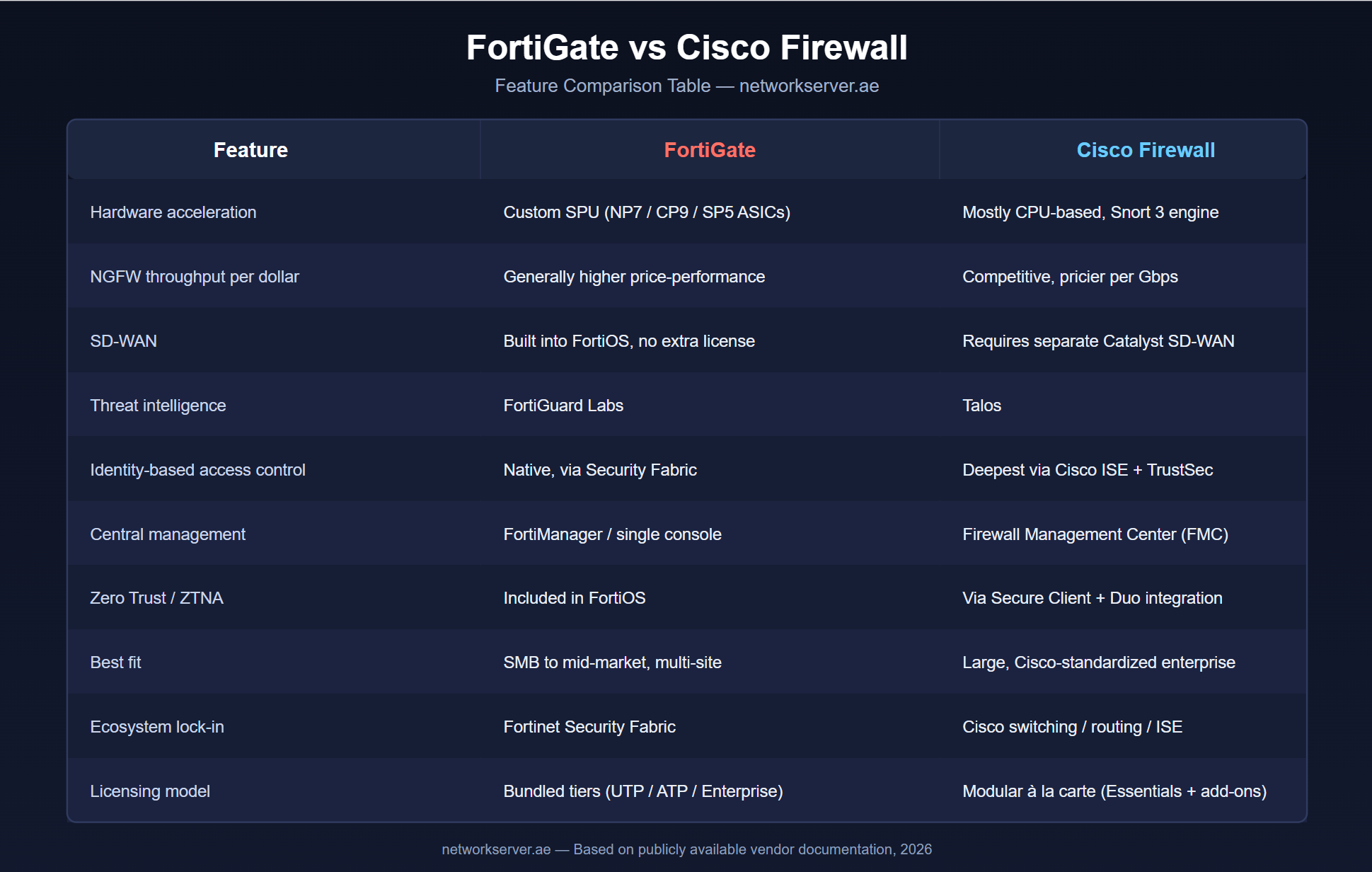
FortiGate vs Cisco Firewall: Feature Comparison Table
Performance: Where the Hardware Difference Actually Shows Up
This is the part most comparison articles skip, and it matters more than any spec sheet number.
FortiGate’s dedicated SPU hardware means the CPU isn’t doing double duty. In real-world testing, a mid-range FortiGate can maintain full-speed TLS/SSL inspection at low CPU load, while a comparable Cisco Firepower appliance running the same workload in software can see CPU usage climb much higher under the same traffic. The practical effect: FortiGate tends to hold its rated throughput even with every security feature (IPS, antivirus, application control, SSL inspection) switched on at once — which is the realistic way any business actually runs a firewall.
Cisco has closed some of this gap with the Snort 3 engine on its newer Firepower 7.4 releases, and its high-end chassis-based platforms (like the Firepower 4100/9300 series) are genuinely powerful — but they’re also priced and positioned for large enterprise data centers, not typical SMB or mid-market deployments.
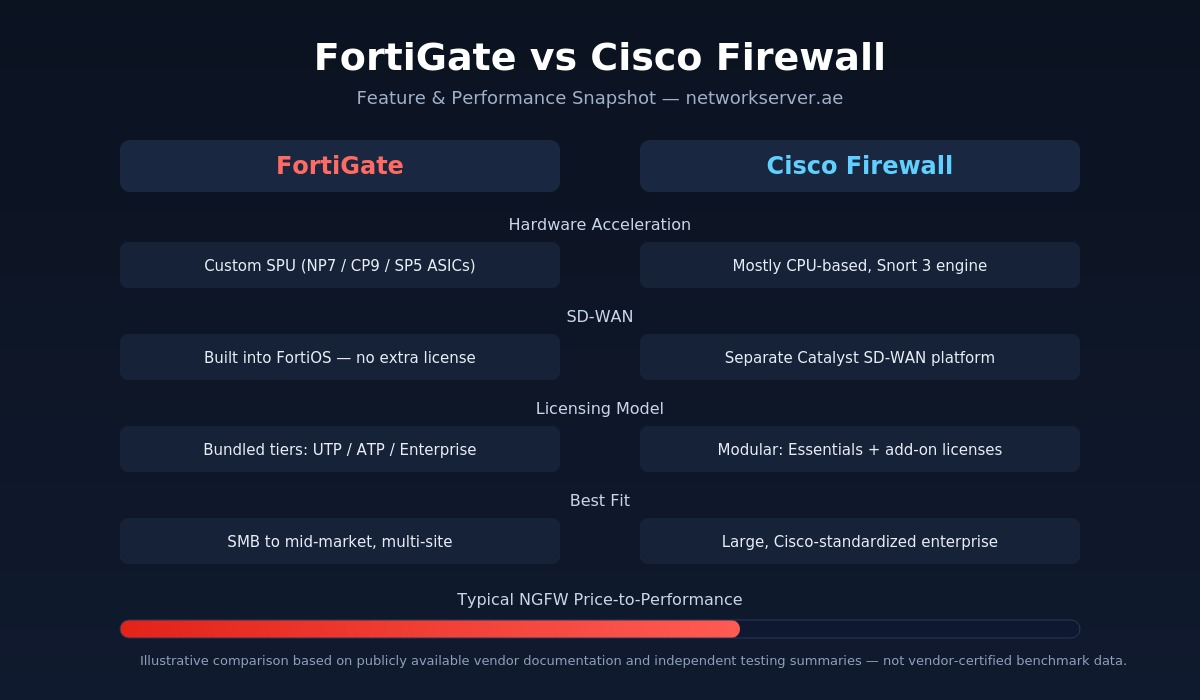
Bottom line: for most businesses, FortiGate usually delivers better NGFW throughput per dollar spent. Cisco’s strength shows up more in large-scale, Cisco-native environments where the firewall is one component of a much bigger integrated system.
FortiGate Licensing Explained
FortiGate licensing is bundled into three main tiers, which makes budgeting fairly predictable:
UTP (Unified Threat Protection) The most popular tier for SMBs. Includes IPS, antivirus, application control, web/DNS filtering, and FortiCare support. Covers essential threat protection without paying for enterprise-only extras.
ATP (Advanced Threat Protection) IPS, antivirus with cloud sandboxing, application control, and FortiCare Premium support. A lighter, slightly lower-cost bundle than UTP, aimed at businesses that want strong core protection without full web/DNS filtering.
Enterprise builds on UTP with SaaS application security, data loss prevention, IoT device protection, and FortiCare 360 (24×7 support plus a dedicated Technical Account Manager). Meant for larger or more complex environments.
Every bundle includes FortiCare technical support and 24×7×365 coverage options, and the license is tied to the firewall hardware — so once you know your FortiGate model and required tier, the annual cost is easy to forecast.
Cisco Firewall Licensing Explained
Cisco’s licensing works differently — it’s modular rather than fully bundled:
Essentials license— comes included with every Secure Firewall purchase. Covers core networking and security functions: switching, routing, high availability, clustering, user and application control.
Add-on licenses (purchased separately): IPS, Malware Defense, and URL Filtering — each is its own subscription, layered on top of Essentials.
Broader Cisco Security Suites (User Protection, Breach Protection, Cloud Protection) — for organizations buying Cisco security at scale, licensed per-user with Advantage/Premier tiers, often managed through Enterprise Agreements.
This à la carte structure gives large enterprises more granular control over exactly what they’re paying for — but it also means the total cost of ownership is less predictable up front, and typically higher once IPS, malware defense, and URL filtering are all added, especially for smaller deployments.
FortiGate Pros and Cons
Pros:
– Strong price-to-performance ratio thanks to ASIC-based SPU hardware
– Secure SD-WAN built into FortiOS at no extra license cost
– Single management console across firewall, switching, and Wi-Fi (Security Fabric)
– Predictable, bundled licensing that’s easy to budget for
– Wide range of models suited to SMB, branch, and mid-market deployments
– Consistently ranked as a Leader in the Gartner Magic Quadrant for Network Firewalls
Cons:
– Smaller native ecosystem outside of Fortinet’s own product line
– Advanced enterprise orchestration features require the higher-cost Enterprise tier
– Less deep identity-based policy control than Cisco ISE/TrustSec for very large, segmented networks
Cisco Firewall Pros and Cons
Pros:
– Deep integration with Cisco switches, routers, and Cisco ISE for identity-based access
– Talos threat intelligence — one of the largest threat research teams in the industry
– Strong fit for large, already-standardized Cisco enterprise networks
– Granular, modular licensing lets large organizations pay only for what they use
– Well established in regulated sectors — banking, government, telecom
Cons:
– Higher total cost of ownership once IPS, malware defense, and URL filtering are added
– CPU-based inspection can mean higher resource usage under full security load on entry/mid-range models
– SD-WAN requires a separate platform (Catalyst SD-WAN), adding cost and complexity
– Steeper learning curve and more moving parts (FMC, ISE, TrustSec) for smaller IT teams to manage
—
Which Firewall Should UAE Businesses Choose?
For most small and mid-sized businesses across Dubai, Abu Dhabi, and the wider UAE, FortiGate is the more practical choice: lower total cost of ownership, SD-WAN included out of the box, and a single console that a lean IT team can actually manage without hiring a specialist for every product. It’s also why FortiGate shows up so often in SMB and mid-market firewall shortlists here — the hardware acceleration keeps performance high even on entry-level appliances, which matters when you’re running a branch office or a growing e-commerce operation on a fixed IT budget.
Cisco Firewall makes more sense if your organization already runs on Cisco switching, routing, and ISE — banks, large enterprises, government entities, and telecom operators, where the firewall is one piece of a much larger Cisco-standardized network and the integration benefits outweigh the added licensing complexity.
If you’re not sure which category your business falls into, the questions worth asking are: *Do you already own Cisco networking gear? Do you have (or plan to hire) dedicated network security staff? Is SD-WAN part of your roadmap?* If the answer to those is mostly “no,” FortiGate is very likely your better starting point.
—
Frequently Asked Questions
Is FortiGate cheaper than Cisco Firewall?
In most cases, yes. FortiGate’s bundled licensing and ASIC-accelerated hardware generally deliver a lower total cost of ownership than Cisco Firewall, where IPS, malware defense, and URL filtering are licensed separately on top of the base Essentials license.
Which firewall has better performance, FortiGate or Cisco?
FortiGate typically holds higher NGFW throughput under full security inspection (IPS, antivirus, SSL inspection all enabled) because of its dedicated SPU hardware. Cisco’s high-end chassis platforms are very capable but are built and priced for large enterprise data centers.
Does FortiGate include SD-WAN?
Yes. Secure SD-WAN is built directly into FortiOS at no additional license cost. Cisco requires a separate platform, Catalyst SD-WAN (formerly Viptela), which adds cost and complexity.
Can I upgrade my FortiGate or Cisco firewall license later?
Yes, both vendors support moving to a higher license tier as your business grows — FortiGate by upgrading from UTP/ATP to Enterprise, and Cisco by adding IPS, Malware Defense, or URL Filtering entitlements on top of Essentials, or moving into a broader Security Suite.
Which firewall is better for a small business in the UAE?
For most small and mid-sized UAE businesses, FortiGate is the more cost-effective and easier-to-manage option. Cisco Firewall is worth considering mainly if you’re already standardized on Cisco networking equipment.
Final Thoughts
There’s no single “best” firewall — there’s a firewall that’s best for your network. FortiGate wins on price-performance, built-in SD-WAN, and simplicity, which is why it’s the safer default for most SMB and mid-market businesses. Cisco Firewall wins when deep, identity-based integration with an existing Cisco environment matters more than upfront cost.
Still not sure which one fits your setup? Talk to the networkserver.ae team — we supply, license, and configure both FortiGate and Cisco firewalls across the UAE, and we can size the right model and licensing bundle for your network before you spend a single dirham.
 Share
Share