 Login/Register


FortiGate vs Cisco Firewall: Which One Should You Buy?
Choosing the right firewall is an important decision for any business. A firewall protects your network, controls traffic, helps prevent unauthorized access and can provide additional security features such as intrusion prevention, VPN, application control and threat detection.
Two well-known options are FortiGate from Fortinet and Cisco Secure Firewall from Cisco. Both are powerful enterprise-grade firewall platforms, but they take slightly different approaches to network security and management.
So, FortiGate vs Cisco Firewall — which one should you buy?
The answer depends on your network size, security requirements, existing infrastructure, budget and the level of management you need.
FortiGate vs Cisco Firewall at a Glance
| Feature | FortiGate | Cisco Secure Firewall |
|---|---|---|
| Next-generation firewall | Yes | Yes |
| Intrusion prevention | Yes | Yes |
| VPN | Yes | Yes |
| Application control | Yes | Yes |
| Threat intelligence | FortiGuard | Cisco Talos |
| Centralized management | FortiManager / FortiCloud | Security Cloud Control / FMC |
| SD-WAN | Integrated | Available |
| Zero Trust capabilities | Yes | Yes |
| Hardware options | Wide range | Wide range |
| Virtual/cloud options | Yes | Yes |
| Best suited for | SMB to enterprise | Mid-size to large enterprise and complex environments |
Both platforms provide substantially more than basic firewall filtering. FortiGate combines networking and security through FortiOS, while Cisco Secure Firewall integrates advanced threat protection, application visibility, intrusion prevention and centralized policy management.
What Is FortiGate?
FortiGate is Fortinet’s next-generation firewall platform. It is designed to combine firewall security with networking capabilities such as secure SD-WAN and zero-trust access.
Fortinet uses purpose-built security processors in many FortiGate platforms to accelerate security and networking functions. Fortinet also offers FortiGuard security services for capabilities such as intrusion prevention, malware protection, web security and DNS filtering.
This makes FortiGate particularly attractive to organizations looking for a firewall that combines security and networking features in one platform.
Advantages of FortiGate
- Strong firewall and security performance
- Integrated SD-WAN capabilities
- Wide range of hardware models
- FortiGuard threat protection services
- Centralized management options
- VPN and zero-trust capabilities
- Suitable for branch and enterprise deployments
- Strong integration with the Fortinet Security Fabric
FortiGate is available in different form factors, including physical appliances, virtual machines and cloud-native deployments.
Advantages of Cisco Firewall
- Strong enterprise security capabilities
- Cisco Talos threat intelligence
- Snort intrusion prevention technology
- Application visibility and control
- Centralized firewall management
- VPN capabilities
- SD-WAN capabilities
- Strong integration with Cisco networking environments
- Options for data center, branch, cloud and IoT deployments
Cisco Secure Firewall is particularly interesting for organizations already operating a large Cisco network because keeping security and networking within the same ecosystem can simplify integration and administration.
FortiGate vs Cisco Firewall: Security
Security is usually the first consideration when purchasing a firewall.
FortiGate uses FortiGuard security services and FortiOS capabilities to provide protection against malware, intrusion attempts, botnets, web threats and other security risks. Fortinet also provides AI-powered security services and multiple security-service bundles.
Cisco Secure Firewall uses Cisco Talos threat intelligence together with technologies including Snort ML for threat detection and protection. Cisco also provides visibility into encrypted traffic through its Encrypted Visibility Engine.
Winner: It’s difficult to declare one universal winner. Both provide strong enterprise security. Your choice should depend on the specific security features, performance requirements and subscriptions required for your environment.
FortiGate vs Cisco Firewall: Performance
Performance depends heavily on the specific model and configuration.
FortiGate’s architecture makes extensive use of purpose-built security processors designed to accelerate security functions. This can make FortiGate attractive when organizations need strong security performance without unnecessarily increasing hardware requirements.
Cisco also offers high-performance Secure Firewall appliances. For example, current Cisco Secure Firewall platforms include models designed for demanding data-center environments with high firewall, IPS and VPN throughput.
Don’t compare brands using the maximum firewall throughput alone. When choosing a firewall, look at the performance of the features you will actually use, such as IPS, VPN, SSL/TLS inspection and threat protection.
FortiGate vs Cisco Firewall: Management
Management can make a significant difference to the overall firewall experience.
Fortinet provides management options including FortiManager and FortiCloud, allowing organizations to manage security policies and multiple devices from centralized platforms.
Cisco provides centralized management through its firewall management ecosystem, including Security Cloud Control and Firewall Management Center. Cisco describes these tools as ways to centralize firewall administration, policies and security operations.
For a small IT team, the simplicity of the management interface and the amount of configuration required should be an important consideration.
FortiGate vs Cisco Firewall: SD-WAN
If your business has multiple offices or relies heavily on internet-based connectivity between branches, SD-WAN can be an important factor.
FortiGate integrates secure SD-WAN capabilities into its platform, allowing organizations to combine security and WAN connectivity.
Cisco Secure Firewall also provides SD-WAN capabilities, including application-aware routing, multiple ISP support, ECMP and high-availability options.
Winner: Both are strong choices. Your existing network infrastructure may be the deciding factor.
FortiGate vs Cisco Firewall: Licensing and Cost
The purchase price of a firewall is only part of the total cost.
You should consider:
- Hardware cost
- Security subscriptions
- Support
- Threat intelligence services
- VPN requirements
- Management software
- Renewal costs
- Number of users and sites
- Required bandwidth
- High-availability requirements
FortiGate security services are available through FortiGuard subscriptions and bundles, while Cisco has its own licensing and support structure.
For this reason, it is better to compare the total cost of ownership rather than simply comparing the purchase price of two firewall appliances.
Which Firewall Is Better for Small Businesses?
For a small or medium-sized business, FortiGate can be an attractive option when the company wants firewall security, VPN, SD-WAN and other networking capabilities in one platform.
Cisco can also be an excellent choice, particularly when the business already has Cisco switches, routers, wireless infrastructure or other Cisco security products.
The best choice is therefore not necessarily the firewall with the lowest price. It is the platform that fits your existing infrastructure and future plans.
Which Firewall Is Better for Large Enterprises?
Large organizations often have more complicated requirements involving multiple locations, data centers, cloud infrastructure, segmentation, centralized management and advanced security policies.
Both FortiGate and Cisco Secure Firewall can support these environments.
Cisco may be particularly attractive for organizations heavily invested in the Cisco ecosystem, while Fortinet can be attractive for organizations looking for a unified security and networking platform across branches, campus and other environments.
FortiGate or Cisco Firewall: Which Should You Buy?
There is no single firewall that is best for every business.
Choose FortiGate if you want:
- Strong security performance
- Integrated SD-WAN
- A broad range of appliance options
- Fortinet Security Fabric integration
- A unified networking and security platform
- A solution suitable for SMB through enterprise deployments
Choose Cisco Secure Firewall if you want:
- Strong Cisco ecosystem integration
- Cisco Talos threat intelligence
- Snort-based threat protection
- Advanced enterprise security capabilities
- Centralized management
- Integration with complex Cisco environments
Final Verdict
So, FortiGate vs Cisco Firewall: which one should you buy?
For many businesses looking for a combination of security, networking and centralized management, FortiGate is a very strong choice. Its integrated SD-WAN capabilities, security services and broad product range make it suitable for many SMB and enterprise environments.
Cisco Secure Firewall is also an excellent choice, especially for organizations already invested heavily in Cisco networking and security technologies. Its Talos threat intelligence, Snort technology and enterprise management capabilities make it a strong option for complex networks.
Before buying, compare the exact models based on your required throughput, IPS performance, VPN capacity, subscriptions, support and number of users.
Need Help Choosing a Firewall in the UAE?
If you are looking for FortiGate or Cisco firewall solutions in the UAE, NetworkServer.ae can help you identify suitable hardware based on your network requirements and budget.
Whether you are upgrading an existing firewall, setting up a new office network or replacing an older security appliance, choosing the right model is more important than simply choosing a brand.
Contact NetworkServer.ae to check available FortiGate and Cisco firewall hardware in the UAE.
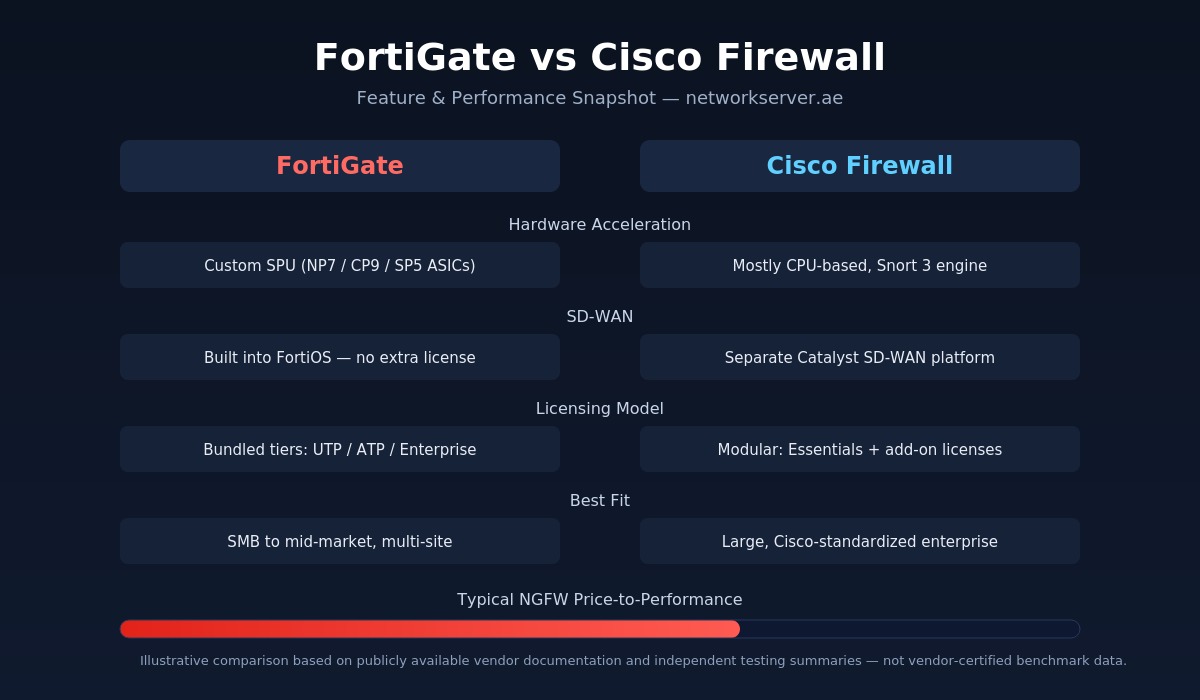
Bottom line: for most businesses, FortiGate usually delivers better NGFW throughput per dollar spent.
FortiGate Licensing Explained
FortiGate licensing is bundled into three main tiers, which makes budgeting fairly predictable:
UTP (Unified Threat Protection) The most popular tier for SMBs. Includes IPS, antivirus, application control, web/DNS filtering, and FortiCare support. Covers essential threat protection without paying for enterprise-only extras.
ATP (Advanced Threat Protection) IPS, antivirus with cloud sandboxing, application control, and FortiCare Premium support. A lighter, slightly lower-cost bundle than UTP, aimed at businesses that want strong core protection without full web/DNS filtering.
>Enterprise builds on UTP with SaaS application security, data loss prevention, IoT device protection, and FortiCare 360 (24×7 support plus a dedicated Technical Account Manager). Meant for larger or more complex environments.
Every bundle includes FortiCare technical support and 24×7×365 coverage options, and the license is tied to the firewall hardware — so once you know your FortiGate model and required tier, the annual cost is easy to forecast.
Cisco Firewall Licensing Explained
Cisco’s licensing works differently — it’s modular rather than fully bundled:
Essentials license— comes included with every Secure Firewall purchase. Covers core networking and security functions: switching, routing, high availability, clustering, user and application control.
Add-on licenses (purchased separately): IPS, Malware Defense, and URL Filtering — each is its own subscription, layered on top of Essentials.
Broader Cisco Security Suites (User Protection, Breach Protection, Cloud Protection) — for organizations buying Cisco security at scale, licensed per-user with Advantage/Premier tiers, often managed through Enterprise Agreements.
This à la carte structure gives large enterprises more granular control over exactly what they’re paying for — but it also means the total cost of ownership is less predictable up front, and typically higher once IPS, malware defense, and URL filtering are all added, especially for smaller deployments.
FortiGate Pros and Cons
Pros:
– Strong price-to-performance ratio thanks to ASIC-based SPU hardware
– Secure SD-WAN built into FortiOS at no extra license cost
– Single management console across firewall, switching, and Wi-Fi (Security Fabric)
– Predictable, bundled licensing that’s easy to budget for
– Wide range of models suited to SMB, branch, and mid-market deployments
– Consistently ranked as a Leader in the Gartner Magic Quadrant for Network Firewalls
Cons:
– Smaller native ecosystem outside of Fortinet’s own product line
– Advanced enterprise orchestration features require the higher-cost Enterprise tier
– Less deep identity-based policy control than Cisco ISE/TrustSec for very large, segmented networks
Cisco Firewall Pros and Cons
Pros:
– Deep integration with Cisco switches, routers, and Cisco ISE for identity-based access
– Talos threat intelligence — one of the largest threat research teams in the industry
– Strong fit for large, already-standardized Cisco enterprise networks
– Granular, modular licensing lets large organizations pay only for what they use
– Well established in regulated sectors — banking, government, telecom
Cons:
– Higher total cost of ownership once IPS, malware defense, and URL filtering are added
– CPU-based inspection can mean higher resource usage under full security load on entry/mid-range models
– SD-WAN requires a separate platform (Catalyst SD-WAN), adding cost and complexity
– Steeper learning curve and more moving parts (FMC, ISE, TrustSec) for smaller IT teams to manage
Which Firewall Should UAE Businesses Choose?
For most small and mid-sized businesses across Dubai, Abu Dhabi, and the wider UAE, FortiGate is the more practical choice: lower total cost of ownership, SD-WAN included out of the box, and a single console that a lean IT team can actually manage without hiring a specialist for every product. It’s also why FortiGate shows up so often in SMB and mid-market firewall shortlists here — the hardware acceleration keeps performance high even on entry-level appliances, which matters when you’re running a branch office or a growing e-commerce operation on a fixed IT budget.
Cisco Firewall makes more sense if your organization already runs on Cisco switching, routing, and ISE — banks, large enterprises, government entities, and telecom operators, where the firewall is one piece of a much larger Cisco-standardized network and the integration benefits outweigh the added licensing complexity.
Frequently Asked Questions
Is FortiGate cheaper than Cisco Firewall?
FortiGate’s bundled licensing and ASIC-accelerated hardware generally deliver a lower total cost of ownership than Cisco Firewall, where IPS, malware defense, and URL filtering are licensed separately on top of the base Essentials license.
Which firewall has better performance, FortiGate or Cisco?
FortiGate typically holds higher NGFW throughput under full security inspection (IPS, antivirus, SSL inspection all enabled) because of its dedicated SPU hardware. Cisco’s high-end chassis platforms are very capable but are built and priced for large enterprise data centers.
Does FortiGate include SD-WAN?
Yes. Secure SD-WAN is built directly into FortiOS at no additional license cost. Cisco requires a separate platform, Catalyst SD-WAN (formerly Viptela), which adds cost and complexity.
Can I upgrade my FortiGate or Cisco firewall license later?
Yes, both vendors support moving to a higher license tier as your business grows — FortiGate by upgrading from UTP/ATP to Enterprise, and Cisco by adding IPS, Malware Defense, or URL Filtering entitlements on top of Essentials, or moving into a broader Security Suite.
Which firewall is better for a small business in the UAE?
For most small and mid-sized UAE businesses, FortiGate is the more cost-effective and easier-to-manage option. Cisco Firewall is worth considering mainly if you’re already standardized on Cisco networking equipment.
Final Thoughts
Cisco Firewall wins when deep, identity-based integration with an existing Cisco environment matters more than upfront cost. Still not sure which one fits your setup? Talk to the networkserver.ae team — we supply, license, and configure both FortiGate and Cisco firewalls across the UAE, and we can size the right model and licensing bundle for your network before you spend a single dirham.
 Share